
Industrial Water Filtration Systems & Commercial Water Treatment Solutions
Industrial water treatment equipment treats water across the full contamination spectrum, from produced water and PFAS-contaminated groundwater to cooling tower water, process wastewater, and industrial process fluids.
Every system is designed and configured to your process rather than adapted from a standard package.
The production process is designed to meet environmental compliance requirements and/or to support your operational infrastructure.
In the sections below, you’ll discover proven technology for your specific application, along with individual product pages for specifications and configuration options.


Water Contamination Types and Industrial Applications
Different contamination profiles require different filtration approaches, and no two industrial water treatment challenges are identical. These systems are deployed across a wide range of contamination types and operating environments.
Industrial water filtration solutions are in stock or custom built for the following water types and contamination challenges:
- Produced water from oil and gas operations containing hydrocarbons and suspended solids
- Industrial wastewater generated by manufacturing and processing operations
- PFAS-contaminated water requiring specialized media and treatment chemistry
- Groundwater remediation for environmental compliance and site cleanup projects
- Cooling tower water requiring suspended solids removal and biological control
- Process water for facilities requiring clean water as an input to production
- Chemical remediation and discharge water requiring treatment prior to release
Whether your requirement is filtration, separation, purification, or a combination of all three, you’ll get a completely configured commercial and industrial water filtration systems that meet your discharge limits and operational demands.
Industrial Water Filtration System Types
Choose from 6 standard configurations or request custom engineering covering the full range of industrial water filtration and water purification technology.
The sections below outline each system type, how it works, and where it is most commonly used. Each links to a dedicated product page with technical specifications and configuration details.

Media Filtration and Physical Separation
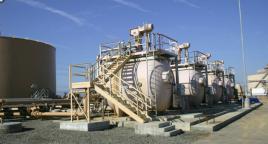
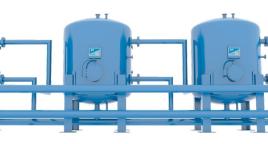
Walnut shell media filters use a downflow, deep bed design specifically built for oily water filtration.
The nutshell media captures suspended oils and solids from water streams in a continuous operation, making them a common choice for produced water treatment and industrial oily water applications where high throughput and media durability are required.
Dissolved air flotation systems remove suspended solids, greases, and oils by injecting fine air bubbles into the liquid stream. The bubbles attach to contaminants and float them to the surface for removal.
DAF systems are widely used in wastewater treatment, food processing, and industrial process water applications where gravity separation alone is insufficient for the contamination load.
Ion Exchange and Water Purification
Ion exchange systems use purification vessels loaded with resin to remove specific dissolved contaminants from water by trading ions within the resin bed.
This approach is typically used when the contamination target is a specific dissolved species, such as heavy metals, nitrates, or other ionic compounds that physical filtration cannot capture.
These water purification systems are engineered as skid-mounted platforms for industrial and pilot-scale applications. They are designed for facilities that need a compact, configurable purification system that can be integrated into an existing water treatment process or operated as a standalone unit.
Modular and Mobile Water Treatment Systems
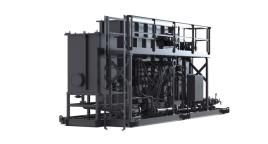
Modular water treatment systems are pre-fabricated, multi-module systems assembled at our facility and configured as a complete treatment train.
Each module handles a specific treatment function, and the full system is designed to be shipped, installed, and commissioned with minimal on-site construction. These systems handle flow rates from 0 to 500 GPM and can be custom configured for larger project specifications.
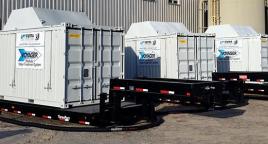
Mobile water filtration systems are skid-mounted or container-based units designed for portability and rapid deployment.
They are often used for temporary treatment applications, emergency response, remote site operations, and situations where permanent infrastructure is not practical or available.
Custom Water Treatment System Design and Engineering
Every industrial water filtration system you are looking for starts with the contamination profile of your specific water source.
You see, there is no standard system that fits every industrial water treatment challenge, and there are very few pre-packaged configurations that require your process to adapt to the equipment.
Fortunately, our engineering process evaluates your source water chemistry, target contaminant levels, required flow rate, discharge requirements, and available facility space before specifying any equipment.
That process is what gets you custom-built water treatment solutions that perform to specification from day one rather than requiring field adjustments after installation.
Systems operating in facilities across industries include oil and gas, chemical processing, municipal water treatment, automotive manufacturing, food and beverage, environmental remediation, and industrial manufacturing.
As a commercial water filtration system manufacturer with operations in 47 countries, your system will be configured for your contamination type and regulatory environment that vary significantly from one region and industry to the next.
For facilities evaluating multiple industrial water filtration companies, the differentiator is engineering depth and a direct relationship between your team and ours throughout the design, build, and commissioning process.
Talk to a Filtration Engineer at Filtra-Systems
When you are evaluating industrial water filtration systems or need a custom water treatment system designed around your specific process, this engineering team will be happy to assess your requirements and recommend the no-risk strategy, technology, and configuration for your process and facility.
Call us at 248-427-9090 or submit a contact form and we will respond promptly.
Frequently Asked Questions
Filtration refers specifically to the physical removal of suspended particles, solids, or undissolved contaminants from water using a filter medium.
Water treatment is a broader term that includes filtration but also encompasses chemical dosing, biological processes, ion exchange, dissolved air flotation, and other processes that address dissolved contaminants, biological contamination, or water chemistry.
Most industrial water treatment systems combine multiple technologies to address the full range of contaminants present in the source water.
The right system depends on four primary variables: your source water chemistry and contamination type, the flow rate your process requires, the target water quality at the outlet, and your discharge or reuse requirements.
A facility treating produced water from oil and gas operations has different requirements than one treating cooling tower blowdown or PFAS-contaminated groundwater.
In house engineers assigned to your project evaluates each of these variables before recommending a specific technology or system configuration.
Yes, except PFAS removal requires specific treatment technologies.
Granular activated carbon and ion exchange resins are among the most commonly used approaches for PFAS removal, and the right media selection depends on the specific PFAS compounds present and their concentrations.
Your assigned engineer will evaluate your water chemistry and regulatory requirements before specifying a PFAS treatment configuration. This is not a one-size-fits-all problem, and the treatment approach needs to match the PFAS profile of the specific water source.
Lead time depends on the complexity of the system, the filtration technologies involved, and current production schedules.
Modular systems designed and pre-fabricated in our facility typically move faster than fully custom engineered field installations because the module design is standardized even when the configuration is unique.
Mobile filtration units designed for rapid deployment are also available on shorter lead times than permanent custom installations.
Your point of contact provides a project-specific timeline estimate after the system design is finalized.
A modular water treatment system is a permanent or semi-permanent installation made up of pre-fabricated modules that are assembled at our facility and installed at your site as a complete treatment train. It is designed for facilities that need a full treatment solution without the cost and time of on-site custom construction.
A mobile water filtration system is designed specifically for portability, using skid-mounted or containerized equipment that can be relocated, transported to remote sites, or deployed for temporary applications.
The two serve different operational needs, and some facilities use both.
Yes. Rental filtration systems are available for facilities that need a temporary treatment solution, are managing a short-term remediation project, or need to meet a compliance deadline before permanent equipment is installed.
And, consider this: rental units eliminate the capital outlay of purchasing a permanent system and can be deployed quickly when treatment needs are urgent.
Whether rental or permanent installation makes more sense depends on your timeline, budget, and application—an engineer evaluates all three before making a recommendation to you.
Not sure what type of filtration you need or have questions about your equipment?
Ask our team of experienced applications engineers to review your application, process, and facility and make recommendations that will be best for your manufacturing, production and bottom line.

